Teaching Math
Instructor Resources
-
-
-
-
-
Wigwametry: K-12 Geometry Unit
"This culturally integrated and
responsive unit will help students
understand the mathematical,
historical, and social importance of
the wigwam structure in Northern
Woodland cultures." Math topics include circles, area, volume, etc.
-
Decolonizing Mathematics Curriculum and Pedagogy: Indigenous Knowledge Has Always Been Mathematics Education
Describes a program that " seeks to decolonize mathematics education through 4 curricular examples rooted in Indigenous place-based education, with the components of belonging, mastery, independence, and generosity (BMIG), and Indigenous mathematics knowledge."
-
Towards an Accessible Mathematics Working Environment Based on Isabelle/VSCode
This "paper collects preparatory work for interdisciplinary collaboration between three partners, between (1) experts in improving accessibility of studies for impaired individuals, (2) experts in developing educational mathematics software and (3) experts in designing and implementing interactive proof assistants. . . . Major efforts have been undertaken to make the Internet accessible and the resulting browser technology, among others, is a great success. However mathematical content raises specific issues due to the structure of mathematical formulas, symbolic calculations and proofs."
-
Using Artificial Intelligence (AI) to Improve Math Accessibility for Students with Visual Impairments. Technical Brief
"This study, which is part of a larger project that aims to make online math more accessible to students with visual impairments (VI), examines the text quality of math assessment items for students with VI who use screen readers." 2022
-
Looking beyond Vision: Supports for Students Who Are Blind or Visually Impaired in Mathematics
"This review examines research on math achievement in students who are blind or visually impaired (BVI), and seeks to show the opportunities that BVIs have access to in order to demonstrate their knowledge of mathematics as well as the unique challenges they face and the ways in which these barriers have (or have not) been addressed."
-
Taking Universal Design Back to Its Roots: Perspectives on Accessibility and Identity in Undergraduate Mathematics
This study " investigated the perceptions of three disabled students who took part in an undergraduate mathematics course designed with the principles of Universal Design for Learning and Assessment . . . and concluded "that Universal Design should be returned to its roots by connecting it with the social model of disability."
-
The Accessibility of Mathematical Notation on the Web and Beyond
Published in the Journal of Science Education for Students with Disabilities, 2020.
-
WCAG 2.1 Meets STEM: Application, Interpretation, and Opportunities for Further Standard Development
"This paper offers an overview of changes introduced in the recent Web Content Accessibility Guidelines (WCAG) 2.1 standard that have implications for the accessibility of content in science, technology, engineering and mathematics (STEM) disciplines." 2019.
-
-
-
Social Justice Driven STEM: Achieving Equity Goals through Integrated Mathematics Education
From the Proceedings of the 40th annual meeting of
the North American Chapter of the International Group for the Psychology of Mathematics
Education, 2018.
-
-
-
An Experiment in Active Learning: The Effects of Teams
" In this paper, an experiment in active learning utilizing team-based adaptive online quizzes in an introductory math finance course involving 378 undergraduate students over two years is conducted to explore the potency of this active learning methodology compared to a control group with traditional teaching."
-
-
Math in Society from a Diversity and Social Justice Lens (online textbook)
Mathematical concepts applied to such topics as minimum wages, population growth, vehicles' energy efficiency, income disparities, health disparities, etc. "[E]ach section of the textbook has a way that students can 'learn by watching' or 'learn by reading,' according to their preference. All concepts are covered using each method." From Lake Washington Institute of Technology.
Featured Books and eBooks
-
-
-
 African Mathematics: From Bones to Computers
by
Mamokgethi Setati; Abdul Karim Bangura
This is the first comprehensive text on standardized and other tests, performance factors, student characteristics, cross-cultural differences and studies, literacy, native speakers, social class and differences, equal education, teaching methods, knowledge level, educational guidelines and policies, transitional schools, comparative education, other subjects such as physics and social studies, surveys, talent, educational research, teacher education and qualifications, academic standards, teacher effectiveness, lesson plans and modules, teacher characteristics, instructional materials, program effectiveness, program evaluation, African culture, African history, Black studies, class activities, educational games, number systems, cognitive ability, foreign influence, and fundamental concepts. What unifies the chapters in this book can appear rather banal, but many mathematical insights are so obvious and so fundamental that they are difficult to absorb, appreciate, and express with fresh clarity. Some of the more basic insights are isolated by accounts of investigators who have earned their contemporaries' respect. Winner of the 2012 Cecil B. Currey Book Award.
African Mathematics: From Bones to Computers
by
Mamokgethi Setati; Abdul Karim Bangura
This is the first comprehensive text on standardized and other tests, performance factors, student characteristics, cross-cultural differences and studies, literacy, native speakers, social class and differences, equal education, teaching methods, knowledge level, educational guidelines and policies, transitional schools, comparative education, other subjects such as physics and social studies, surveys, talent, educational research, teacher education and qualifications, academic standards, teacher effectiveness, lesson plans and modules, teacher characteristics, instructional materials, program effectiveness, program evaluation, African culture, African history, Black studies, class activities, educational games, number systems, cognitive ability, foreign influence, and fundamental concepts. What unifies the chapters in this book can appear rather banal, but many mathematical insights are so obvious and so fundamental that they are difficult to absorb, appreciate, and express with fresh clarity. Some of the more basic insights are isolated by accounts of investigators who have earned their contemporaries' respect. Winner of the 2012 Cecil B. Currey Book Award.
Call Number: Ebook
ISBN: 1282922165
Publication Date: 2011
-
-
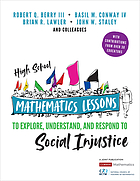 High School Mathematics Lessons to Explore, Understand, and Respond to Social Injustice
by
Robert Q. Berry III; Robert Q. et al.
In main collection. "The "lessons in this book explain how to teach mathematics for self- and community-empowerment. It walks teachers step-by-step through the process of using mathematics--across all high school content domains--as a tool to explore, understand, and respond to issues of social injustice including: environmental injustice; wealth inequality; food insecurity; and gender, LGBTQ, and racial discrimination. This book features: Content cross-referenced by mathematical concept and social issues Downloadable instructional materials for student use User-friendly and logical interior design for daily use Guidance for designing and implementing social justice lessons driven by your own students' unique passions and challenges."
High School Mathematics Lessons to Explore, Understand, and Respond to Social Injustice
by
Robert Q. Berry III; Robert Q. et al.
In main collection. "The "lessons in this book explain how to teach mathematics for self- and community-empowerment. It walks teachers step-by-step through the process of using mathematics--across all high school content domains--as a tool to explore, understand, and respond to issues of social injustice including: environmental injustice; wealth inequality; food insecurity; and gender, LGBTQ, and racial discrimination. This book features: Content cross-referenced by mathematical concept and social issues Downloadable instructional materials for student use User-friendly and logical interior design for daily use Guidance for designing and implementing social justice lessons driven by your own students' unique passions and challenges."
Call Number: 510.712 B534h 2020
ISBN: 9781544352596
Publication Date: 2020
-
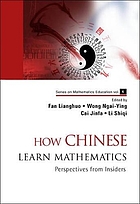 How Chinese Learn Mathematics: Perspectives from Insiders
by
Gerald Edward Brown; Chang-Hwan Lee; Lianghuo Fan (Editor); Ngai-Ying Wong (Editor); Jinfaand Cai (Editor); Shiqi Li (Editor)
The book has been written by an international group of very active researchers and scholars who have a passion for the study of Chinese mathematics education. It aims to provide readers with a comprehensive and updated picture of the teaching and learning of mathematics involving Chinese students from various perspectives, including the ways in which Chinese students learn mathematics in classrooms, schools and homes, the influence of the cultural and social environment on Chinese students' mathematics learning, and the strengths and weaknesses of the ways in which Chinese learn mathematics. Furthermore, based on the relevant research findings, the book explores the implications for mathematics education and offers sound suggestions for reform and improvement. This book is a must for anyone who is interested in the teaching and learning of mathematics concerning Chinese learners. Contents: "Overview and International Perspectives: "How Have Chinese Students Performed in Mathematics? A Perspective from Large-Scale International Comparisons "(L-H Fan & Y Zhu)"The Mathematics Curriculum: Toward Globalization or Westernization? "(N-Y Wong et al.)"Thinking Mathematically by Chinese Learners: A Cross-National Comparative Perspective "(J-F Cai & V Cifarelli)"An Examination of Coherence in a Chinese Mathematics Classroom "(T Wang & J Murphy)"A Chinese Cultural Model of Learning "(J Li)"Official Curriculum in Mathematics in Ancient China: How Did Candidates Study for the Examination? "(M K Siu)""Context and Teaching Materials: "The “Two Basics” Mathematics Teaching and Learning in Mainland China "(D-Z Zhang et al.)"A Comparative Study on Composite Difficulty between New and Old Chinese Mathematics Textbooks "(J-S Bao)"Textbook Use Within and Beyond Chinese Mathematics Classrooms: A Study of 12 Secondary Schools in Kunming and Fuzhou of China "(L-H Fan et al.)"Thorough Understanding of the Textbook: A Significant Feature of Chinese Teacher Manuals "(J-H Li)"Effects of Cram Schools on Children's Mathematics Learning "(H M Huang)""Pedagogy and Learning Processes: "Teaching with Variation: A Chinese Way of Promoting Effective Mathematics Learning "(L-Y Gu et al.)"Cracking the Paradox of Chinese Learners: Looking into the Mathematics Classrooms in Hong Kong and Shanghai "(R-J Huang & K S Leung)"Identifying a Pattern of Teaching: An Analysis of a Shanghai Teacher's Lessons "(F Lopez-Real et al.)"Differences Within Communalities: How Is Mathematics Taught in Rural and Urban Regions in Mainland China? "(Y-P Ma et al.)"Teaching Approach: Theoretical or Experimental? "(J Li)"Capturing the Chinese Way of Teaching: The Learning-Questioning and Learning-Reviewing Instructional Model "(S-H An)"The Effects of Different Representations on Mathematics Learning of Chinese Children "(B-Y Xu)""Inspiration and Future Directions: "The CHC Learner's Phenomenon: Its Implications on Mathematics Education "(N-Y Wong)"How Do Chinese Learn Mathematics? Some Evidence-Based Insights and Needed Directions "(J-F Cai et al.)" Readership: Researchers, educators, lecturers, and graduate students in mathematics and education.
How Chinese Learn Mathematics: Perspectives from Insiders
by
Gerald Edward Brown; Chang-Hwan Lee; Lianghuo Fan (Editor); Ngai-Ying Wong (Editor); Jinfaand Cai (Editor); Shiqi Li (Editor)
The book has been written by an international group of very active researchers and scholars who have a passion for the study of Chinese mathematics education. It aims to provide readers with a comprehensive and updated picture of the teaching and learning of mathematics involving Chinese students from various perspectives, including the ways in which Chinese students learn mathematics in classrooms, schools and homes, the influence of the cultural and social environment on Chinese students' mathematics learning, and the strengths and weaknesses of the ways in which Chinese learn mathematics. Furthermore, based on the relevant research findings, the book explores the implications for mathematics education and offers sound suggestions for reform and improvement. This book is a must for anyone who is interested in the teaching and learning of mathematics concerning Chinese learners. Contents: "Overview and International Perspectives: "How Have Chinese Students Performed in Mathematics? A Perspective from Large-Scale International Comparisons "(L-H Fan & Y Zhu)"The Mathematics Curriculum: Toward Globalization or Westernization? "(N-Y Wong et al.)"Thinking Mathematically by Chinese Learners: A Cross-National Comparative Perspective "(J-F Cai & V Cifarelli)"An Examination of Coherence in a Chinese Mathematics Classroom "(T Wang & J Murphy)"A Chinese Cultural Model of Learning "(J Li)"Official Curriculum in Mathematics in Ancient China: How Did Candidates Study for the Examination? "(M K Siu)""Context and Teaching Materials: "The “Two Basics” Mathematics Teaching and Learning in Mainland China "(D-Z Zhang et al.)"A Comparative Study on Composite Difficulty between New and Old Chinese Mathematics Textbooks "(J-S Bao)"Textbook Use Within and Beyond Chinese Mathematics Classrooms: A Study of 12 Secondary Schools in Kunming and Fuzhou of China "(L-H Fan et al.)"Thorough Understanding of the Textbook: A Significant Feature of Chinese Teacher Manuals "(J-H Li)"Effects of Cram Schools on Children's Mathematics Learning "(H M Huang)""Pedagogy and Learning Processes: "Teaching with Variation: A Chinese Way of Promoting Effective Mathematics Learning "(L-Y Gu et al.)"Cracking the Paradox of Chinese Learners: Looking into the Mathematics Classrooms in Hong Kong and Shanghai "(R-J Huang & K S Leung)"Identifying a Pattern of Teaching: An Analysis of a Shanghai Teacher's Lessons "(F Lopez-Real et al.)"Differences Within Communalities: How Is Mathematics Taught in Rural and Urban Regions in Mainland China? "(Y-P Ma et al.)"Teaching Approach: Theoretical or Experimental? "(J Li)"Capturing the Chinese Way of Teaching: The Learning-Questioning and Learning-Reviewing Instructional Model "(S-H An)"The Effects of Different Representations on Mathematics Learning of Chinese Children "(B-Y Xu)""Inspiration and Future Directions: "The CHC Learner's Phenomenon: Its Implications on Mathematics Education "(N-Y Wong)"How Do Chinese Learn Mathematics? Some Evidence-Based Insights and Needed Directions "(J-F Cai et al.)" Readership: Researchers, educators, lecturers, and graduate students in mathematics and education.
Call Number: Ebook
ISBN: 1281347604
Publication Date: 2004
-


 Reaching and Teaching Students in Poverty: Strategies for Erasing the Opportunity Gap
by
Reaching and Teaching Students in Poverty: Strategies for Erasing the Opportunity Gap
by
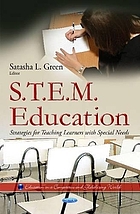 S. T. E. M. Education: Strategies for Teaching Learners with Special Needs
by
"Individuals with disabilities have been underrepresented in STEM fields for many years. . . .[The] need to provide general and special education teachers practices and strategies to improve outcomes for students with disabilities in STEM areas is imperative."
S. T. E. M. Education: Strategies for Teaching Learners with Special Needs
by
"Individuals with disabilities have been underrepresented in STEM fields for many years. . . .[The] need to provide general and special education teachers practices and strategies to improve outcomes for students with disabilities in STEM areas is imperative."
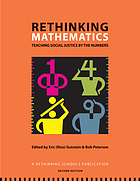 Rethinking Mathematics: Teaching Social Justice by the Numbers
by
Over 50 articles "show how to weave social justice issues throughout the mathematics curriculum, as well as how to integrate mathematics into other curricular areas. Rethinking Mathematics offers teaching ideas, lesson plans, and reflections by practitioners and mathematics educators."
Rethinking Mathematics: Teaching Social Justice by the Numbers
by
Over 50 articles "show how to weave social justice issues throughout the mathematics curriculum, as well as how to integrate mathematics into other curricular areas. Rethinking Mathematics offers teaching ideas, lesson plans, and reflections by practitioners and mathematics educators."
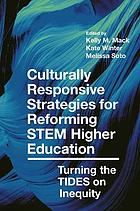 Culturally Responsive Strategies for Reforming STEM Higher Education: Turning the TIDES on Inequity
by
In Main collection. "This practical guide provides a durable platform for building capacity in understanding of the cultural complexities and institutional realities of recruiting and retaining diverse students in STEM, particularly the computer sciences."
Culturally Responsive Strategies for Reforming STEM Higher Education: Turning the TIDES on Inequity
by
In Main collection. "This practical guide provides a durable platform for building capacity in understanding of the cultural complexities and institutional realities of recruiting and retaining diverse students in STEM, particularly the computer sciences."