

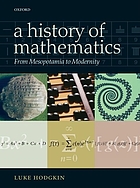
 History of Mathematics: From Mesopotamia to Modernity
by
"It begins in Babylon, then describes the trials and tribulations of the Greek mathematicians. The important, and often neglected, influence of both Chinese and Islamic mathematics is covered in detail, placing the description of early Western mathematics in a global context."
History of Mathematics: From Mesopotamia to Modernity
by
"It begins in Babylon, then describes the trials and tribulations of the Greek mathematicians. The important, and often neglected, influence of both Chinese and Islamic mathematics is covered in detail, placing the description of early Western mathematics in a global context."
 The History of Mathematics: A Brief Course
by
The History of Mathematics: A Brief Course
by
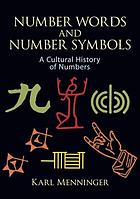 Number Words and Number Symbols: A Cultural History of Numbers
by
Number Words and Number Symbols: A Cultural History of Numbers
by
 Mathematics Across Cultures: The History of Non-Western Mathematics
by
In Main collection. "Mathematics Across Cultures: A History of Non-Western Mathematics consists of essays dealing with the mathematical knowledge and beliefs of cultures outside the United States and Europe. In addition to articles surveying Islamic, Chinese, Native American, Aboriginal Australian, Inca, Egyptian, and African mathematics, among others, the book includes essays on Rationality, Logic and Mathematics, and the transfer of knowledge from East to West. The essays address the connections between science and culture and relate the mathematical practices to the cultures which produced them. Each essay is well illustrated and contains an extensive bibliography. Because the geographic range is global, the book fills a gap in both the history of science and in cultural studies. It should find a place on the bookshelves of advanced undergraduate students, graduate students, and scholars, as well as in libraries serving those groups."
Mathematics Across Cultures: The History of Non-Western Mathematics
by
In Main collection. "Mathematics Across Cultures: A History of Non-Western Mathematics consists of essays dealing with the mathematical knowledge and beliefs of cultures outside the United States and Europe. In addition to articles surveying Islamic, Chinese, Native American, Aboriginal Australian, Inca, Egyptian, and African mathematics, among others, the book includes essays on Rationality, Logic and Mathematics, and the transfer of knowledge from East to West. The essays address the connections between science and culture and relate the mathematical practices to the cultures which produced them. Each essay is well illustrated and contains an extensive bibliography. Because the geographic range is global, the book fills a gap in both the history of science and in cultural studies. It should find a place on the bookshelves of advanced undergraduate students, graduate students, and scholars, as well as in libraries serving those groups."
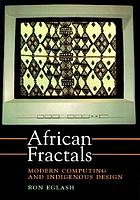 African Fractals: Modern Computing and Indigenous Design
by
In Main collection. " Drawing on interviews with African designers, artists, and scientists, Ron Eglash investigates fractals in African architecture, traditional hairstyling, textiles, sculpture, painting, carving, metalwork, religion, games, practical craft, quantitative techniques, and symbolic systems. He also examines the political and social implications."
African Fractals: Modern Computing and Indigenous Design
by
In Main collection. " Drawing on interviews with African designers, artists, and scientists, Ron Eglash investigates fractals in African architecture, traditional hairstyling, textiles, sculpture, painting, carving, metalwork, religion, games, practical craft, quantitative techniques, and symbolic systems. He also examines the political and social implications."
 African Mathematics: From Bones to Computers
by
This is the first comprehensive text on standardized and other tests, performance factors, student characteristics, cross-cultural differences and studies, literacy, native speakers, social class and differences, equal education, teaching methods, knowledge level, educational guidelines and policies, transitional schools, comparative education, other subjects such as physics and social studies, surveys, talent, educational research, teacher education and qualifications, academic standards, teacher effectiveness, lesson plans and modules, teacher characteristics, instructional materials, program effectiveness, program evaluation, African culture, African history, Black studies, class activities, educational games, number systems, cognitive ability, foreign influence, and fundamental concepts. What unifies the chapters in this book can appear rather banal, but many mathematical insights are so obvious and so fundamental that they are difficult to absorb, appreciate, and express with fresh clarity. Some of the more basic insights are isolated by accounts of investigators who have earned their contemporaries' respect. Winner of the 2012 Cecil B. Currey Book Award.
African Mathematics: From Bones to Computers
by
This is the first comprehensive text on standardized and other tests, performance factors, student characteristics, cross-cultural differences and studies, literacy, native speakers, social class and differences, equal education, teaching methods, knowledge level, educational guidelines and policies, transitional schools, comparative education, other subjects such as physics and social studies, surveys, talent, educational research, teacher education and qualifications, academic standards, teacher effectiveness, lesson plans and modules, teacher characteristics, instructional materials, program effectiveness, program evaluation, African culture, African history, Black studies, class activities, educational games, number systems, cognitive ability, foreign influence, and fundamental concepts. What unifies the chapters in this book can appear rather banal, but many mathematical insights are so obvious and so fundamental that they are difficult to absorb, appreciate, and express with fresh clarity. Some of the more basic insights are isolated by accounts of investigators who have earned their contemporaries' respect. Winner of the 2012 Cecil B. Currey Book Award.
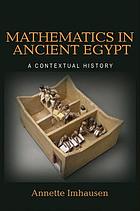 Mathematics in Ancient Egypt
by
"A survey of ancient Egyptian mathematics across three thousand years Mathematics in Ancient Egypt traces the development of Egyptian mathematics, from the end of the fourth millennium BC--and the earliest hints of writing and number notation--to the end of the pharaonic period in Greco-Roman times. Drawing from mathematical texts, architectural drawings, administrative documents, and other sources, Annette Imhausen surveys three thousand years of Egyptian history to present an integrated picture of theoretical mathematics in relation to the daily practices of Egyptian life and social structures. Imhausen shows that from the earliest beginnings, pharaonic civilization used numerical techniques to efficiently control and use their material resources and labor. Even during the Old Kingdom, a variety of metrological systems had already been devised. By the Middle Kingdom, procedures had been established to teach mathematical techniques to scribes in order to make them proficient administrators for their king. Imhausen looks at counterparts to the notation of zero, suggests an explanation for the evolution of unit fractions, and analyzes concepts of arithmetic techniques. She draws connections and comparisons to Mesopotamian mathematics, examines which individuals in Egyptian society held mathematical knowledge, and considers which scribes were trained in mathematical ideas and why. Of interest to historians of mathematics, mathematicians, Egyptologists, and all those curious about Egyptian culture, Mathematics in Ancient Egypt sheds new light on a civilization's unique mathematical evolution."
Mathematics in Ancient Egypt
by
"A survey of ancient Egyptian mathematics across three thousand years Mathematics in Ancient Egypt traces the development of Egyptian mathematics, from the end of the fourth millennium BC--and the earliest hints of writing and number notation--to the end of the pharaonic period in Greco-Roman times. Drawing from mathematical texts, architectural drawings, administrative documents, and other sources, Annette Imhausen surveys three thousand years of Egyptian history to present an integrated picture of theoretical mathematics in relation to the daily practices of Egyptian life and social structures. Imhausen shows that from the earliest beginnings, pharaonic civilization used numerical techniques to efficiently control and use their material resources and labor. Even during the Old Kingdom, a variety of metrological systems had already been devised. By the Middle Kingdom, procedures had been established to teach mathematical techniques to scribes in order to make them proficient administrators for their king. Imhausen looks at counterparts to the notation of zero, suggests an explanation for the evolution of unit fractions, and analyzes concepts of arithmetic techniques. She draws connections and comparisons to Mesopotamian mathematics, examines which individuals in Egyptian society held mathematical knowledge, and considers which scribes were trained in mathematical ideas and why. Of interest to historians of mathematics, mathematicians, Egyptologists, and all those curious about Egyptian culture, Mathematics in Ancient Egypt sheds new light on a civilization's unique mathematical evolution."