

 What's Next for Student Veterans? Moving from Transition to Academic Success
by
With the passage of the Post-9/11 GI Bill in 2008, more than 1.4 million service members and their families became eligible for higher education benefits, and veterans from the wars in Iraq and Afghanistan enrolled in colleges and universities in record numbers. The first wave of research about these new student veterans focused primarily on describing their characteristics and the transition from military service to civilian life and the college campus. This new edited collection presents findings from the second wave of research about student veterans, with a focus on data-driven evidence of academic success factors, including persistence, retention, degree completion, and employment after college. An invaluable resource for educators poised to enter the next phase of supporting military-connected college students.
What's Next for Student Veterans? Moving from Transition to Academic Success
by
With the passage of the Post-9/11 GI Bill in 2008, more than 1.4 million service members and their families became eligible for higher education benefits, and veterans from the wars in Iraq and Afghanistan enrolled in colleges and universities in record numbers. The first wave of research about these new student veterans focused primarily on describing their characteristics and the transition from military service to civilian life and the college campus. This new edited collection presents findings from the second wave of research about student veterans, with a focus on data-driven evidence of academic success factors, including persistence, retention, degree completion, and employment after college. An invaluable resource for educators poised to enter the next phase of supporting military-connected college students.
 Veterans' Education: School Recruitment and Informed Decision Issues
by
Veterans' Education: School Recruitment and Informed Decision Issues
by
 From the Marine Corps to College: Transitioning from the Service to Higher Education
by
From the Marine Corps to College: Transitioning from the Service to Higher Education
by
 Writing Programs, Veterans Studies, and the Post-9/11 University: A Field Guide
by
Writing Programs, Veterans Studies, and the Post-9/11 University: A Field Guide
by
 Failing Our Veterans: The G.I. Bill and the Vietnam Generation
by
Failing Our Veterans: The G.I. Bill and the Vietnam Generation
by
 When Dreams Came True: The GI Bill and the Making of Modern America
by
When Dreams Came True: The GI Bill and the Making of Modern America
by
 Life During College: The Veteran's Guide to Success
by
Life During College: The Veteran's Guide to Success
by
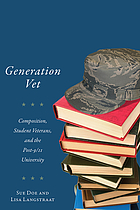 Generation Vet : Composition, Student Veterans, and the Post-9/11 University
by
"Institutions of higher education are experiencing the largest influx of enrolled veterans since World War II, and these student veterans are transforming post-secondary classroom dynamics. While many campus divisions like admissions and student services are actively moving to accommodate the rise in this demographic, little research about this population and their educational needs is available, and academic departments have been slower to adjust. In Generation Vet, fifteen chapters offer well-researched, pedagogically savvy recommendations for curricular and programmatic responses to student veterans for English and writing studies departments. In work with veterans in writing-intensive courses and community contexts, questions of citizenship, disability, activism, community-campus relationships, and retention come to the fore. Moreover, writing-intensive courses can be sites of significant cultural exchanges--even clashes--as veterans bring military values, rhetorical traditions, and communication styles that may challenge the values, beliefs, and assumptions of traditional college students and faculty. This classroom-oriented text addresses a wide range of issues concerning veterans, pedagogy, rhetoric, and writing program administration. Written by diverse scholar-teachers and written in diverse genres, the essays in this collection promise to enhance our understanding of student veterans, composition pedagogy and administration, and the post-9/11 university."
Generation Vet : Composition, Student Veterans, and the Post-9/11 University
by
"Institutions of higher education are experiencing the largest influx of enrolled veterans since World War II, and these student veterans are transforming post-secondary classroom dynamics. While many campus divisions like admissions and student services are actively moving to accommodate the rise in this demographic, little research about this population and their educational needs is available, and academic departments have been slower to adjust. In Generation Vet, fifteen chapters offer well-researched, pedagogically savvy recommendations for curricular and programmatic responses to student veterans for English and writing studies departments. In work with veterans in writing-intensive courses and community contexts, questions of citizenship, disability, activism, community-campus relationships, and retention come to the fore. Moreover, writing-intensive courses can be sites of significant cultural exchanges--even clashes--as veterans bring military values, rhetorical traditions, and communication styles that may challenge the values, beliefs, and assumptions of traditional college students and faculty. This classroom-oriented text addresses a wide range of issues concerning veterans, pedagogy, rhetoric, and writing program administration. Written by diverse scholar-teachers and written in diverse genres, the essays in this collection promise to enhance our understanding of student veterans, composition pedagogy and administration, and the post-9/11 university."