Militarization and the Environment
In Guam, even the dead are dying.
As I write this, the US Department of Defense is ramping up the militarization of my homeland - part of its $8 billion scheme to relocate roughly 5.000 Marines from Okinawa to Guam. In fact, ground has already been broken along the island's beautiful northern coastline for a massive firing range complex. The complex - consisting of five live-fire training ranges and support facilities - is being built dangerously close to the island's primary source of drinking water, the Northern Guam Lens Aquifer. Moreover, the complex is situated over several historically and culturally significant sites, including the remnants of ancient villages several thousands of years old, where our ancestors' remains remain.
- Julian Aguon, from in No Country for Eight-Spot Butterflies: A Lyric Essay,
(cited below)
 The War and Environment Reader
by
"While many books have examined the broader topic of military conflict, most neglect to focus on damage military violence inflicts on regionaland globalecosystems. The War and Environment Reader provides a critical analysis of the devastating consequences of "war on the environment" with perspectives drawn from a wide array of diverse voices and global perspectives. The contributors include scores of writers and activists, many with first-hand field experience of war's impacts on nature. Authors include: Medea Benjamin, Helen Caldicott, Marjoie Cohn, Daniel Ellsberg, Robert Fisk, Ann Jones, Michael Klare, Winona LaDuke, Jerry Mander, Margaret Mead, Vandana Shiva, David Swanson, Jody Williams and S. Brian Willson."
The War and Environment Reader
by
"While many books have examined the broader topic of military conflict, most neglect to focus on damage military violence inflicts on regionaland globalecosystems. The War and Environment Reader provides a critical analysis of the devastating consequences of "war on the environment" with perspectives drawn from a wide array of diverse voices and global perspectives. The contributors include scores of writers and activists, many with first-hand field experience of war's impacts on nature. Authors include: Medea Benjamin, Helen Caldicott, Marjoie Cohn, Daniel Ellsberg, Robert Fisk, Ann Jones, Michael Klare, Winona LaDuke, Jerry Mander, Margaret Mead, Vandana Shiva, David Swanson, Jody Williams and S. Brian Willson."
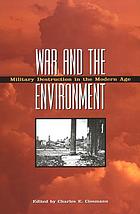 War and the Environment: Military Destruction in the Modern Age
by
"Eleven scholars explore, among other topics, the environmental ravages of trench warfare in World War I, the exploitation of Philippine forests for military purposes from the Spanish colonial period through 1945, William Tecumseh Sherman's scorched-earth tactics during his 1864-65 March to the Sea, and the effects of wartime policy upon U.S. and German conservation practices during World War II."
War and the Environment: Military Destruction in the Modern Age
by
"Eleven scholars explore, among other topics, the environmental ravages of trench warfare in World War I, the exploitation of Philippine forests for military purposes from the Spanish colonial period through 1945, William Tecumseh Sherman's scorched-earth tactics during his 1864-65 March to the Sea, and the effects of wartime policy upon U.S. and German conservation practices during World War II."
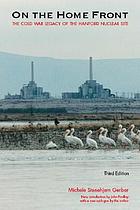 On the Home Front: The Cold War Legacy of the Hanford Nuclear Site
by
On the Home Front: The Cold War Legacy of the Hanford Nuclear Site
by
 Uranium Contamination in the Navajo Nation : Background and Cleanup Efforts
by
"Four million tons of uranium ore were extracted from mines on the Navajo reservation primarily for developing the U.S. nuclear weapons stockpile. For over 30 years, the Navajo people have lived with the environmental and health effects of uranium contamination from this mining. In 2008, five federal agencies adopted a 5-year plan that identified targets for addressing contaminated abandoned mines, structures, water sources, former processing sites, and other sites. Federal agencies also provide funding to Navajo Nation agencies to assist with the cleanup work. This book examines the extent to which the agencies achieved the targets set in the 5-year plan and the reasons why or why not; what is known about the future scope of work, time frames, and costs; and any key challenges faced by the agencies in completing this work and any opportunities to overcome them."
Uranium Contamination in the Navajo Nation : Background and Cleanup Efforts
by
"Four million tons of uranium ore were extracted from mines on the Navajo reservation primarily for developing the U.S. nuclear weapons stockpile. For over 30 years, the Navajo people have lived with the environmental and health effects of uranium contamination from this mining. In 2008, five federal agencies adopted a 5-year plan that identified targets for addressing contaminated abandoned mines, structures, water sources, former processing sites, and other sites. Federal agencies also provide funding to Navajo Nation agencies to assist with the cleanup work. This book examines the extent to which the agencies achieved the targets set in the 5-year plan and the reasons why or why not; what is known about the future scope of work, time frames, and costs; and any key challenges faced by the agencies in completing this work and any opportunities to overcome them."
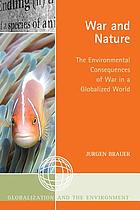 War and Nature: The Environmental Consequences of War in a Globalized World
by
War and Nature: The Environmental Consequences of War in a Globalized World
by
 Environmental Histories of the Cold War
by
"Environmental Histories of the Cold War explores the links between the Cold War and the global environment, ranging from the environmental impacts of nuclear weapons to the political repercussions of environmentalism. Environmental change accelerated sharply during the Cold War years, and so did environmentalism as both a popular movement and a scientific preoccupation. Most Cold War history entirely overlooks this rise of environmentalism and the crescendo of environmental change. These historical subjects were not only simultaneous but also linked together in ways both straightforward and surprising. The contributors to this book present these connected issues as a global phenomenon, with chapters concerning China, the USSR, Europe, North America, Oceania, and elsewhere. The role of experts as agents and advocates of using the environment as a weapon in the Cold War or, contrastingly, of preventing environmental damage resulting from Cold War politics is also given broad attention."
Environmental Histories of the Cold War
by
"Environmental Histories of the Cold War explores the links between the Cold War and the global environment, ranging from the environmental impacts of nuclear weapons to the political repercussions of environmentalism. Environmental change accelerated sharply during the Cold War years, and so did environmentalism as both a popular movement and a scientific preoccupation. Most Cold War history entirely overlooks this rise of environmentalism and the crescendo of environmental change. These historical subjects were not only simultaneous but also linked together in ways both straightforward and surprising. The contributors to this book present these connected issues as a global phenomenon, with chapters concerning China, the USSR, Europe, North America, Oceania, and elsewhere. The role of experts as agents and advocates of using the environment as a weapon in the Cold War or, contrastingly, of preventing environmental damage resulting from Cold War politics is also given broad attention."
 Footprints of War: Militarized Landscapes in Vietnam
by
Footprints of War: Militarized Landscapes in Vietnam
by
 Armed Conflict and Environment: From World War II to Contemporary Asymmetric Warfare
by
"This study. . . analyse[s] the manifold interrelations between armed conflicts and the human and natural environments both historically and sociologically."
Armed Conflict and Environment: From World War II to Contemporary Asymmetric Warfare
by
"This study. . . analyse[s] the manifold interrelations between armed conflicts and the human and natural environments both historically and sociologically."
Aguon, J. (2022). The properties of perpetual light. In No country for eight-spot
butterflies: A lyric essay (p. 8). Astra House.