


A three part series on the Russian Disinformation machine
 Fake News and Alternative Facts: Information Literacy in a Post-Truth Era
by
Fake News and Alternative Facts: Information Literacy in a Post-Truth Era
by
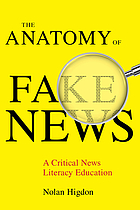 The Anatomy of Fake News: A Critical News Literacy Education
by
"Since the 2016 U.S. presidential election, concerns about fake news have fostered calls for government regulation and industry intervention to mitigate the influence of false content. These proposals are hindered by a lack of consensus concerning the definition of fake news or its origins. Media scholar Nolan Higdon contends that expanded access to critical media literacy education, grounded in a comprehensive history of fake news, is a more promising solution to these issues. The Anatomy of Fake News offers the first historical examination of fake news that takes as its goal the effective teaching of critical news literacy in the United States. Higdon employs a critical-historical media ecosystems approach to identify the producers, themes, purposes, and influences of fake news. The findings are then incorporated into an invaluable fake news detection kit. This much-needed resource provides a rich history and a promising set of pedagogical strategies for mitigating the pernicious influence of fake news."
The Anatomy of Fake News: A Critical News Literacy Education
by
"Since the 2016 U.S. presidential election, concerns about fake news have fostered calls for government regulation and industry intervention to mitigate the influence of false content. These proposals are hindered by a lack of consensus concerning the definition of fake news or its origins. Media scholar Nolan Higdon contends that expanded access to critical media literacy education, grounded in a comprehensive history of fake news, is a more promising solution to these issues. The Anatomy of Fake News offers the first historical examination of fake news that takes as its goal the effective teaching of critical news literacy in the United States. Higdon employs a critical-historical media ecosystems approach to identify the producers, themes, purposes, and influences of fake news. The findings are then incorporated into an invaluable fake news detection kit. This much-needed resource provides a rich history and a promising set of pedagogical strategies for mitigating the pernicious influence of fake news."
 Post-Truth Rhetoric and Composition
by
An "exploration of the increasingly widespread and disturbing effect of "post-truth" on public discourse in the United States. Bruce McComiskey analyzes the instances of bullshit, fake news, feigned ethos, hyperbole, and other forms of post-truth rhetoric employed in recent political discourse."
Post-Truth Rhetoric and Composition
by
An "exploration of the increasingly widespread and disturbing effect of "post-truth" on public discourse in the United States. Bruce McComiskey analyzes the instances of bullshit, fake news, feigned ethos, hyperbole, and other forms of post-truth rhetoric employed in recent political discourse."
 Calling Bullshit: The Art of Scepticism in a Data-Driven World
by
"You don't need a lot of technical expertise to call out problems with data. Are the numbers or results too good or too dramatic to be true? Is the claim comparing like with like? Is it confirming your personal bias? Drawing on a deep well of expertise in statistics and computational biology, Bergstrom and West exuberantly unpack examples of selection bias and muddled data visualization, distinguish between correlation and causation, and examine the susceptibility of science to modern bullshit. We have always needed people who call bullshit when necessary, whether within a circle of friends, a community of scholars, or the citizenry of a nation. Now that bullshit has evolved, we need to relearn the art of skepticism."
In Main collection
Calling Bullshit: The Art of Scepticism in a Data-Driven World
by
"You don't need a lot of technical expertise to call out problems with data. Are the numbers or results too good or too dramatic to be true? Is the claim comparing like with like? Is it confirming your personal bias? Drawing on a deep well of expertise in statistics and computational biology, Bergstrom and West exuberantly unpack examples of selection bias and muddled data visualization, distinguish between correlation and causation, and examine the susceptibility of science to modern bullshit. We have always needed people who call bullshit when necessary, whether within a circle of friends, a community of scholars, or the citizenry of a nation. Now that bullshit has evolved, we need to relearn the art of skepticism."
In Main collection
 Fighting Fake News: A Generational Approach
by
Fighting Fake News: A Generational Approach
by
 Research Anthology on Fake News, Political Warfare, and Combatting the Spread of Misinformation
by
Research Anthology on Fake News, Political Warfare, and Combatting the Spread of Misinformation
by
 Democracy and Fake News: Information Manipulation and Post-Truth Politics
by
The Anatomy of Fake News: A Critical News Literacy Education
by
"Since the 2016 U.S. presidential election, concerns about fake news have fostered calls for government regulation and industry intervention to mitigate the influence of false content. These proposals are hindered by a lack of consensus concerning the definition of fake news or its origins. Media scholar Nolan Higdon contends that expanded access to critical media literacy education, grounded in a comprehensive history of fake news, is a more promising solution to these issues. The Anatomy of Fake News offers the first historical examination of fake news that takes as its goal the effective teaching of critical news literacy in the United States. Higdon employs a critical-historical media ecosystems approach to identify the producers, themes, purposes, and influences of fake news. The findings are then incorporated into an invaluable fake news detection kit. This much-needed resource provides a rich history and a promising set of pedagogical strategies for mitigating the pernicious influence of fake news."
Democracy and Fake News: Information Manipulation and Post-Truth Politics
by
The Anatomy of Fake News: A Critical News Literacy Education
by
"Since the 2016 U.S. presidential election, concerns about fake news have fostered calls for government regulation and industry intervention to mitigate the influence of false content. These proposals are hindered by a lack of consensus concerning the definition of fake news or its origins. Media scholar Nolan Higdon contends that expanded access to critical media literacy education, grounded in a comprehensive history of fake news, is a more promising solution to these issues. The Anatomy of Fake News offers the first historical examination of fake news that takes as its goal the effective teaching of critical news literacy in the United States. Higdon employs a critical-historical media ecosystems approach to identify the producers, themes, purposes, and influences of fake news. The findings are then incorporated into an invaluable fake news detection kit. This much-needed resource provides a rich history and a promising set of pedagogical strategies for mitigating the pernicious influence of fake news."
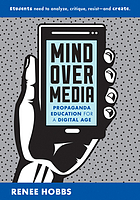 Mind over Media: Propaganda Education for a Digital Age
by
In Main collection.
"Propaganda is inescapable. It's everywhere. Students need to analyze, resist, critique--and create. Media literacy educators have always insisted that we are both creators and receivers of media messages. The truth of this is even more apparent in today's digital environment, with children and adults alike participating in a ubiquitous, nonstop stream of social media. Clearly, students need the tools to interpret news and information critically--not just for school but for life in a "post-truth" world, where the lines blur between entertainment, information, and persuasion. Renee Hobbs demonstrates how a global perspective on contemporary propaganda enables educators to stimulate both the intellectual curiosity and the cultural sensitivities of students. Replete with classroom and online learning activities and samples of student work, Mind Over Media provides a state-of-the-art look at the theory and practice of propaganda in contemporary society, and shows how to build learners' critical thinking and communication skills on topics including computational propaganda, content marketing, fake news, and disinformation."
Mind over Media: Propaganda Education for a Digital Age
by
In Main collection.
"Propaganda is inescapable. It's everywhere. Students need to analyze, resist, critique--and create. Media literacy educators have always insisted that we are both creators and receivers of media messages. The truth of this is even more apparent in today's digital environment, with children and adults alike participating in a ubiquitous, nonstop stream of social media. Clearly, students need the tools to interpret news and information critically--not just for school but for life in a "post-truth" world, where the lines blur between entertainment, information, and persuasion. Renee Hobbs demonstrates how a global perspective on contemporary propaganda enables educators to stimulate both the intellectual curiosity and the cultural sensitivities of students. Replete with classroom and online learning activities and samples of student work, Mind Over Media provides a state-of-the-art look at the theory and practice of propaganda in contemporary society, and shows how to build learners' critical thinking and communication skills on topics including computational propaganda, content marketing, fake news, and disinformation."